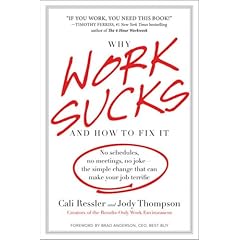
 Is the name of a book that I've recently purchased which explains what they call ROWE: Results-Only Work-Environment.
This book explains a pilot project which was exercised at Best Buy that allows employees total freedom of their time, i.e you can do your work anytime, anywhere and even say no to your boss if your think that a particular work is not worth your time doing.
The authors Cali Ressler and Jodi Thompson (their website here) stresses how we are all tied up to the "old" way of working; How we are judged by our time in the office instead of the actual results that we produce from our work.
The book also explains that in this world of ours, we are constantly bombarded with responsibilities and demands, personal or carrerwise. The dry cleaning, meeting up with friends, picking up the kids from school, the morning meeting at 9 or the weekly reports that we have to send in: These are all demands that we have to attend to but the reality is we do not have the controls to do that. The controls here point to our ability to manage our time. We do not have the controls because we are tied down to a system that was placed a 100 years ago, which most probably had less demands and responsibilities compared to what we are facing now and did not predict that we will get to this point.
Quoting from the book:
When people have high demands and high control, their life can be hectic but manageable. They figure out what needs to be done and when.The book also touches on how the relationship between the manager and the employee changes when they do decide to throw away office time and schedules. The most stressed out word here is trust. You will have to give unconditional trust to your employees or team members to act like responsible adults and deliver, instead of goofing off. The manager and her team members must also agree beforehand on what will they be evaluated on, i.e in what shape will the results of their work be. As long as those expected results are delivered, there is to be no question on how those results are achieved. This in the end, the book says, will strengthen communication instead of weakening it, since the whole team now is focused only on the work and results.
When people have high demands and low control, their life is both hectic and miserable. There is nothing to figure out. They are trapped in a system that piles on the demands but denies them control to meet those demands.
This is why work sucks.
Overall the book gives you a good explaination on what is ROWE, what was their experience and the resistance they initially had when they converted bit-by-bit the workforce at Best Buy to ROWE. At the end of the book they give you tips on how to bring the cause of ROWE to your workplace and how to deal with the skeptics.
The book though does not tell you how to actually roll out ROWE at your workplace. I think the reason behind this is that no two workplace is the same, and while they have the a set of guides that says what and what's not a ROWE, it will be up to the people of those workplaces to find a way to make changes to their working style to match with what ROWE is all about.
Personally I find this way of working fascinating, and is actually what we are trying to achieve. Not so much because I am in the IT industry and we all deal with data all the time and physical presence is not a requirement, but because how the company is set up right now in such a way that we can't afford to look only at people who we can see everyday. Outsourcing or off shoring for example is now not an alternative for us, but more of a necessity to keep everything running and not have to pull straws to see who gets paid this month. By having someone do work without physical presence means that you are forced to look at only one thing to decide if we're getting somehere: The actual results.
The need to be physically present at the office or factory for work for a specified period of time started a long, long time ago, before I or you were born. At that time it was abused too such an extent during the Industrial Revolution and saw women and even children working in poor conditions. With working conditions unregulated, the health, welfare and general well-being of working people suffered. The 8-Hour Day Movement started sometime a century ago to limit the time of work, and since then when we say work, we mean that we are expected to be at the office or factory for 8 hours a day. After more than a 100 years, this practice of attaching time to work still continues. I believe now we come to a point in time that instead of the amount of time actually spent, we should be judged by the value of the results from our work. Time, in it's essence, is actually priceless.


